Back to Providers and provider groups5 min read
Multimodal endpoints, Realtime, and cross-protocol translation
Learn about CCHP's pairwise cross-protocol translation across all endpoint families, OpenAI Responses WebSocket mode, Realtime voice and SIP, async image/video/3D tasks and callbacks, Message Batches, Anthropic Files, and Azure/AWS upstream credentials.
Beyond standard text chat, the CCHP gateway provides pairwise cross-protocol translation across all protocol families, OpenAI Responses WebSocket mode, Realtime voice and video, image/audio/video/3D generation with async tasks, batch and file endpoints, and native cloud authentication for Azure and AWS.
Endpoint protocol picker and pairwise cross-protocol translation v1.0.15+#
Open any provider in Org management → Provider Management and click Add endpoint (or edit an existing endpoint) to configure upstream capabilities with the compact endpoint picker:
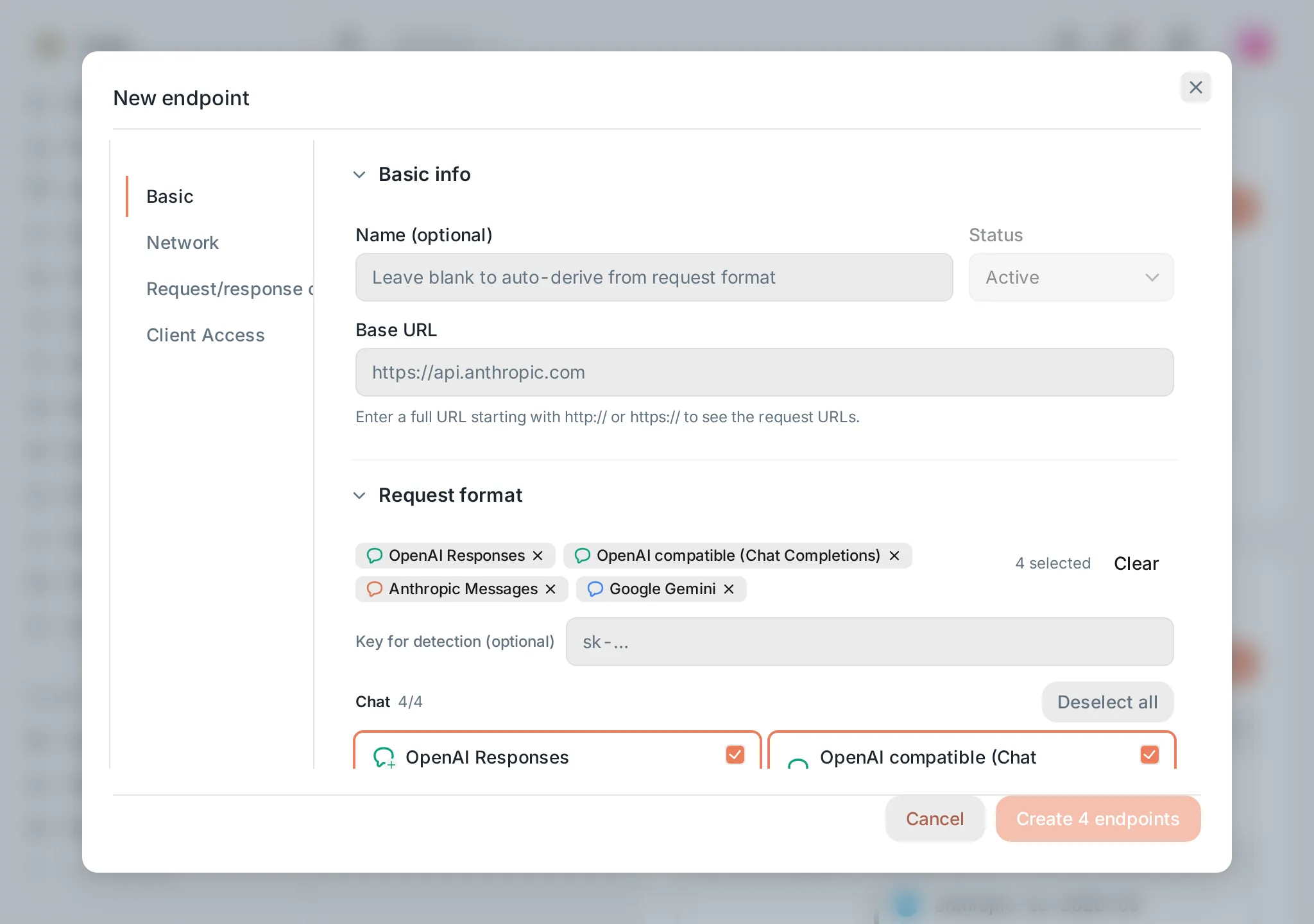 Provider endpoint picker: chat and image quick presets, full protocol family selection, and upstream model discovery
 CCHP
- Quick presets and expand on demand v1.0.15+: Common chat presets (OpenAI Responses, OpenAI Chat Completions, Anthropic Messages, Gemini generateContent / Interactions) and image presets sit at the top, with one click to expand every protocol family. After entering a Base URL and key, you can probe upstream models to help identify supported protocols.
- Pairwise translation across all protocol families v1.0.15+: The gateway translates bidirectionally between OpenAI Chat Completions, OpenAI Responses, Anthropic Messages, Gemini
generateContent(both/v1and/v1betav1.0.13+), Gemini Interactions v1.0.13+, and xAI, while preferring same-protocol passthrough and preserving consistent cross-protocol prompt cache ordering v1.0.14+. - Automatic compatibility normalization: During cross-protocol re-encoding, the gateway pairs tool calls with tool results, maps oversized tool call IDs and invalid function names, handles mid-conversation
systemmessages, enforces Anthropic sampling and thinking-budget constraints, and normalizes structured-outputstrictschemas. Every automatic adjustment is recorded in the request decision chain.
OpenAI Responses WebSocket mode v1.0.13+#
The gateway implements OpenAI Responses over WebSocket (wss://<gateway-host>/v1/responses), letting Codex CLI (with supports_websockets = true) and official OpenAI SDKs stream multi-turn conversations over a single persistent connection:
- Client events: Supports
response.create(including concurrentstream_idchannels—up to 16 in-flight responses and 32 named channels per connection—previous_response_idcontinuation and branching, andgenerate: falsewarmup),response.steer(append input to an active turn), andresponse.interrupt(cancel the active turn). - Upstream connection mode (
executor.responses_websocket): On a provider, provider key, or endpoint, choose Auto (default: prefers upstream WebSocket, seamlessly falls back toPOST /v1/responsesif the upstream does not support WebSocket, and remembers that result in Dragonfly for 1 hour), WebSocket only, or HTTP only. - Managed state: Responses with
store=trueare persisted in gateway conversation history and resume seamlessly across reconnects or when switching back to HTTPPOST /v1/responses.
Realtime sessions and multimodal endpoints v1.0.3+#
CCHP brings unified gateway authentication, limits, routing, and media-aware billing to realtime and multimodal workloads:
Async media tasks, result downloads, and callbacks#
Long-running image, video, audio, and 3D generation calls execute as async tasks and appear in Task History (/app/tasks) in the sidebar (members see their own tasks; admins see tasks within their managed scope):
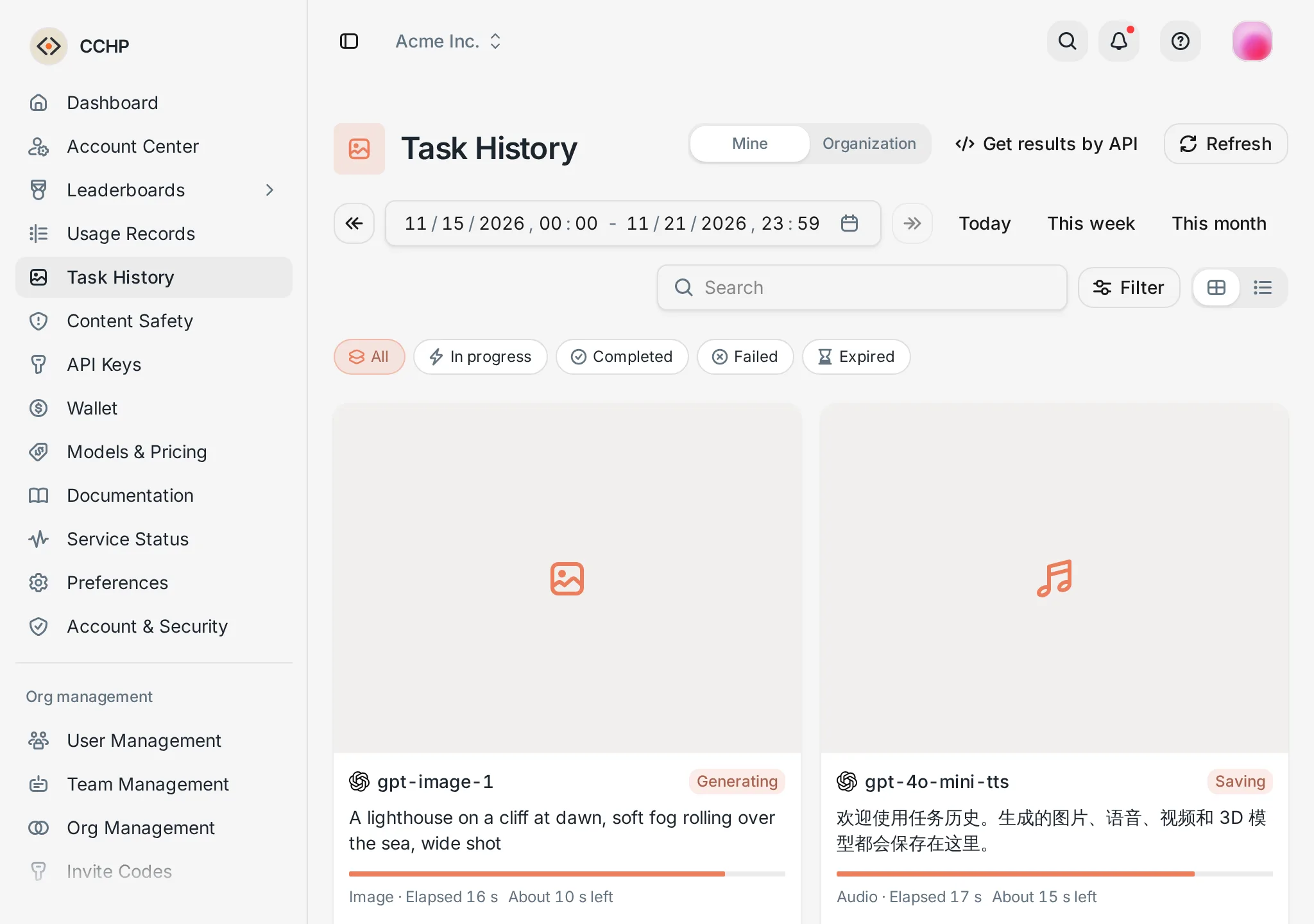 Task History: async image, video, and 3D task list, status filters, and previewsCCHP
- Result storage and retention: Generated artifacts are saved to the platform’s Task result storage (local volume or S3-compatible storage) with inline previews (including 3D models and audio waveforms), per-attempt upstream details, and raw file downloads.
- Synchronous wait and cross-format webhooks v1.0.9+: Callers can pass the
X-CCHP-Waitheader to have the gateway wait within a bounded window and return the finished result inline, or configure a webhook URL to receive signed completion/failure callbacks (unified across video and 3D formats). - Built-in Task results API docs: Open Documentation → Task results (
/app/docs/task-results) in the console for ready-to-run status polling and file download examples pre-populated with your site’s gateway URL:
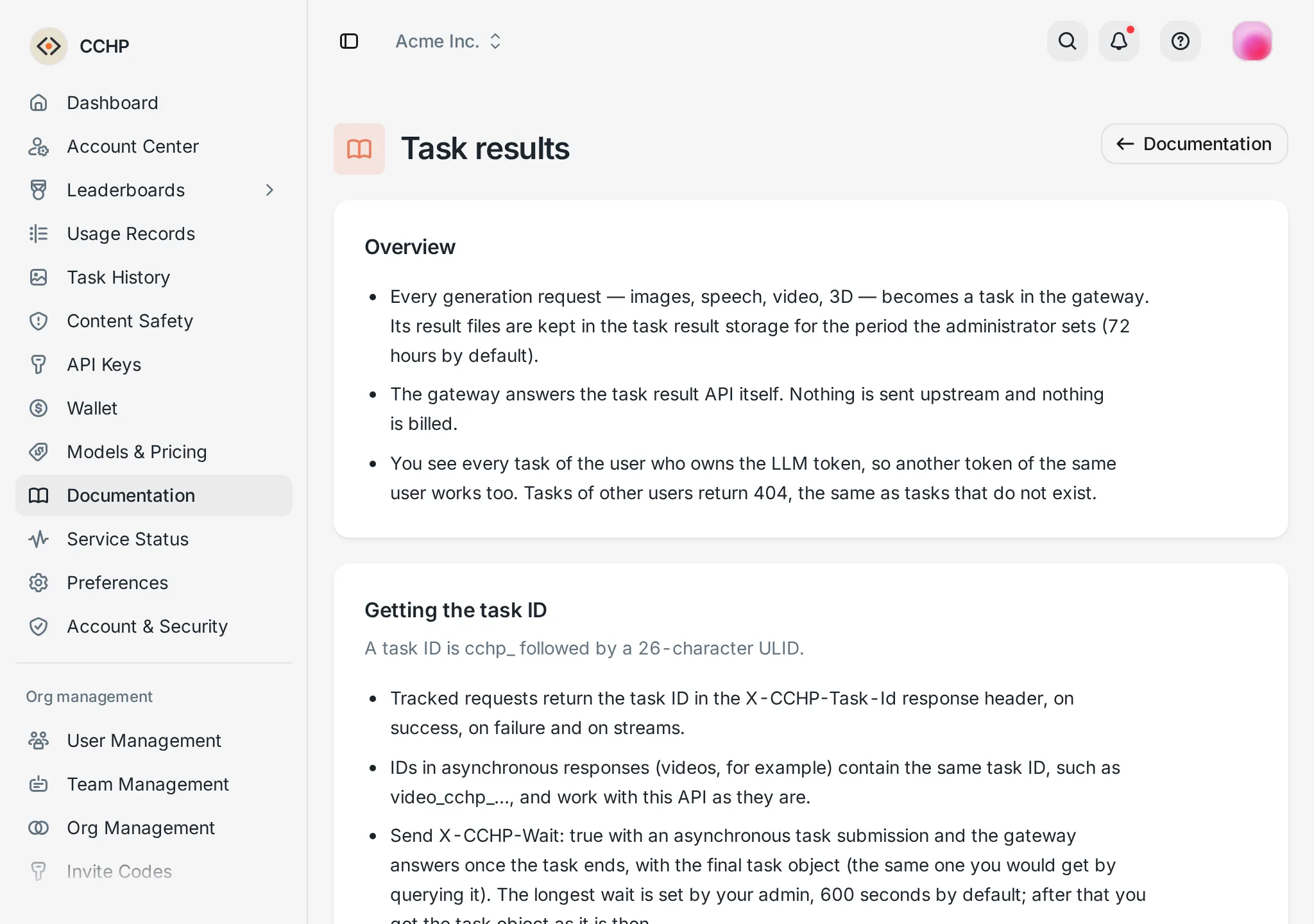 Task results API docs: task ID sources, status and download endpoints, and request examplesCCHP
Batches, files, and Codex remote compaction v1.0.11+#
For long-running agents and bulk inference, CCHP natively supports these extended endpoints:
- Claude Code Message Batches: Full proxying for Anthropic Message Batches creation, status checks, cancellation, and result retrieval, billed at batch pricing tiers.
- Anthropic Files & Google Resumable Upload: Large file uploads, references, and lifecycle management, including the Google Resumable Upload protocol.
- Codex remote compaction v2 and model discovery v1.0.15+: Supports Codex remote context compaction and
api_key_model_discovery, allowing Codex clients to discover available models and context capabilities directly from the gateway.
Cloud upstream authentication (Azure and AWS) v1.0.15+#
Alongside standard API keys, provider and provider key configuration natively supports public cloud LLM authentication:
- Microsoft Azure AI / Azure OpenAI: Supports static API Key credentials as well as Microsoft Entra ID (service principal / managed identity automatic token refresh).
- Amazon Bedrock (AWS SigV4): Configure an Access Key, Secret Key (plus optional Session Token), and target Region; the gateway signs outbound requests with AWS Signature Version 4 automatically with no client-side or external signing proxy required.
Frequently asked questions#
Do I need extra configuration when a client sends OpenAI Chat format to an upstream that only supports Anthropic Messages?#
No. As long as the provider endpoint declares the upstream protocol it supports (such as Anthropic Messages) and the model is in the whitelist, the gateway automatically translates requests and streaming events in both directions when routing selects that candidate, while still preferring same-protocol candidates first.
Why can’t I download result files from a completed async task after some time?#
Task result files follow the retention period configured in Task result storage and are removed automatically by the task_result_retention cron job once expired. Download or copy generated media you need to archive long-term before retention elapses.